Cristian Ciuhuta
1. Congratulations on winning in the European Photography Awards! Can you share a little about yourself, what inspired you to pursue photography, and how has your journey evolved since your first shot?
I am a visual artist and photographer, and photography is one of the ways I investigate the world around me and, perhaps, myself within it.
My first encounter with photography was very personal. Growing up in Transylvania, my father had a small Smena camera and used to photograph family and friends. He even turned our bathroom into a darkroom. I was fascinated by the whole process of making a photograph, from the film to the moment the image appeared on paper. That curiosity never really left me.
Over time, my relationship with photography has become less about capturing something correctly and more about discovering what I can do with what I see. I learned the rules, but eventually I became more interested in knowing when I could leave them behind.
Today I see photography as a space for observation, interpretation and transformation. I am less interested in photographing what something is, and more interested in exploring what else it might become.
2. Can you share the story or inspiration behind your award-winning piece? How does winning this award make you feel about your journey in photography?
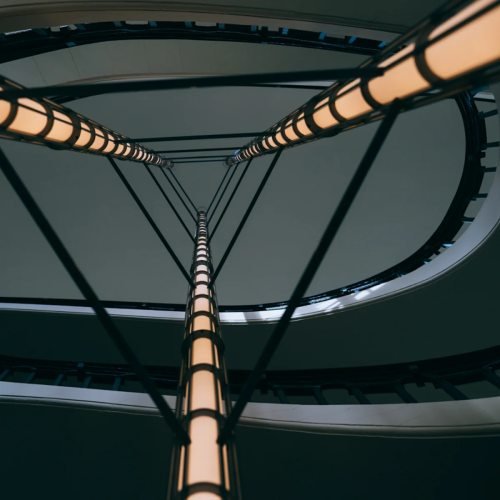
Studies in Orientation began on a cold autumn day in Paris, at the Bourse de Commerce.
While most people were drawn towards the main exhibition space, I became fascinated by a staircase and by the beams of light disappearing into the ceiling. There was something almost infinite about the relationship between the architecture, the light and the vertical space.
I started photographing it from different positions. What surprised me was how completely the feeling of the place changed with each shift in perspective. The same space could become something almost entirely different. That became the starting point for the series.
The award means a great deal to me because it validates something I have increasingly learned to trust: my instinct to stop, look again and follow a visual question without knowing where it will lead.
It gives me confidence, but perhaps even more importantly, it gives me curiosity. I want to return to places, look from different directions and see where the story leads.
3. How do you decide which photo to submit for a competition?
I don’t create photographs specifically for competitions and then try to fit them into a theme. I create first, and sometimes much later I discover that a body of work has something to say in a particular context.
Curating for competitions is something I now enjoy immensely. It allows me to return to photographs I may have taken months or years earlier and experience them again from a different point of view.
I know what happened behind the photographs, what attracted me to the scene and what I was feeling at the time. When I put the images together, I try to move beyond that personal memory and create a sequence in which the photographs begin to speak to one another.
For me, curation is almost another form of photography. It is about choosing, removing, changing orientation and discovering a story that wasn’t necessarily visible in the individual images.
4. What first made you pick up a camera?
I think it was curiosity more than anything else.
As a child, I was fascinated by the possibility that a small object could change the way I experienced the world. I would pick up the camera, experiment with it, look through it from different angles and simply see what happened.
At that age, I wasn’t thinking about photography as an art form. I was playing. I was discovering.
Looking back, I think that feeling has stayed with me. Even today, when I photograph, the most exciting moments are often the ones when I don’t quite know what I am going to find.
That sense of curiosity is probably one of the few things that has remained unchanged since my first photographs.
5. What’s your favorite type of photography, and why do you love it?
I don’t think I have one type of photography that I want to remain inside. I am particularly drawn to nature, street and abstract photography, but I experience them differently. Nature and street photography allow me to observe. They put me in a position of attention, waiting for something to happen or noticing something that might otherwise pass unnoticed.
Abstract photography gives me another kind of freedom. It allows me to interpret, transform and sometimes move away from the original subject completely. That movement between observation and interpretation is important to me.
I don’t really see my practice as being about working in different media or genres. I think of it more as a mixed-dimension practice—moving between different ways of seeing and experiencing reality.
6. What’s your go-to camera setup, and why does it work best for your projects? What’s your favorite feature?
I am a great admirer of Fujifilm, and my main camera is a Fujifilm X-T4. I usually work with the Fujifilm XF 35mm F2 and the XF 16–55mm.
The combination feels very natural to me. The 35mm encourages me to look and move differently, while the zoom gives me the flexibility to respond to architecture, space and changing situations.
But what I particularly love about the Fujifilm experience is its tactile and manual character.
It brings me back to the child who used to play with my father’s camera. There is still something very physical and immediate about making the decisions myself. It puts me into a state of curiosity. And when photography makes me curious, I know I am in the right place.
7. If someone looked at your work, what’s the one thing you’d want them to feel?
I would like them to feel that there is a human being behind the photograph. I am much more interested in sensitivity than in demonstrating technical perfection
Of course, technique matters. I spend a great deal of time learning and refining it. But technique is a language. What interests me is what we choose to say with it.
If someone stops in front of one of my photographs and feels something before they can explain it, or if they look again because they are not quite sure what they are seeing, that is enough for me. I don’t need to give them the answer. I would rather leave a door open.
8. What was the most challenging part of capturing your winning shot?
The challenge was, in a way, accepting that I didn’t need to know what the photographs were for.
I think we often photograph something and immediately begin trying to place it: Where does this belong? What is the story? Is this useful? I have gradually learned to give myself permission to photograph first and understand later.
With Studies in Orientation, I followed my curiosity around that space without knowing that the photographs would eventually become a series, or even that they would be submitted anywhere. The challenge was simply to keep looking.
Sometimes the most important thing we can do as photographers is resist the need to define an image too early.
9. Is there a specific place or subject that inspires you the most?
Japan has been an enormous source of inspiration for me. There is something about the relationship between architecture, nature, people, light and space that I find endlessly fascinating.
But I am equally fascinated by something much more specific: the human element in relation to architecture. I think I am often looking for that meeting point between the human and the constructed world.
10. Who or what has been your biggest influence in photography?
My father was my first influence because he introduced me to photography and, more importantly, to the joy of making images.
If I had to name only one, it would be Saul Leiter. I admire the way he could transform ordinary urban situations through colour, reflections, layers and partial views. His photographs don’t always tell you everything, and I find that very powerful.
I am also fascinated by Zaha Hadid’s architecture. Her work changed the way I looked at architecture. I began to see it less as a collection of straight lines and structures and more as something organic, fluid and almost alive.
In different ways, both Leiter and Hadid encouraged me to look beyond the obvious. There are so many other photographers and artists who continue to inspire me and, hopefully, shape the way I see.
11. What message would you share to inspire photographers to participate in photography awards, and what advice would you give to help them excel in the competition?
I think awards can be valuable even before you win anything. They force you to stop and look at your own work from another perspective. You have to select, remove, sequence and make decisions. You have to stand behind something you created and accept that it will be seen and judged by people who may see things very differently from you. For me, that is one of the most useful parts of the process.
My advice would be not to create work simply because you think a competition wants it. Make the work that interests you first. Then, if you find a place where that work belongs, submit it with conviction.
A competition can be a conversation. And sometimes, even a rejection can tell you something about your work.
12. What’s one piece of advice for someone just starting in photography?
Follow your instinct. Learn the technical side. Learn the rules. Learn from other photographers. But don’t allow external voices to become louder than your own. Give yourself permission to make photographs that you don’t yet understand.
You don’t need to know immediately what your style is, what your project is, or where your work belongs. Keep looking. Keep experimenting. Keep asking questions. And don’t be afraid of uncertainty. Sometimes uncertainty is where the most interesting work begins.
13. What role do editing and post-processing play in your creative workflow?
A very important one. I genuinely enjoy the editing process because for me the photograph doesn’t necessarily finish when I press the shutter.
Many years ago I decided to invest seriously in learning the tools of post-processing, and that knowledge has become part of my creative vocabulary.
I don’t see editing simply as correcting a photograph. It can change emphasis, atmosphere, colour, rhythm and sometimes even the way I understand the original image. It is another stage of looking.
Sometimes I begin editing because I think I know what I want, and the image takes me somewhere else. I enjoy that part—the possibility of discovering something during the process rather than simply executing an idea I already had.
14. How do you see technology, like AI, influencing the future of photography and your own approach?
I think AI will become an increasingly important part of the visual world, and I don’t think photographers can simply ignore that. It can produce extraordinary images. But for me, photography has always been about more than the final image.
There is the place where you stood. The light you noticed. The decision to stop. The uncertainty. The mistakes. The excitement. The memory. The reason you were looking in the first place. All of those things are part of my relationship with a photograph.
AI may create an image, but my interest remains in the experience and intention behind the image. I am less concerned about whether technology can produce something visually beautiful than I am about what makes an image meaningful to the person who created it and to the person who encounters it.
15. If you could photograph anything or anyone in the world, what would it be?
I think I would have difficulty choosing one thing. I would love to photograph Earth from space—to see the planet from a distance that completely changes our sense of scale.
I would love to photograph distant stars, and then go in the opposite direction—to the microscopic structures of nature. They may seem like very different subjects, but for me they are connected.
I am fascinated by changing scale and perspective. I want to see what happens when I move closer, farther away, inside, outside, above or below. Perhaps that is also why the idea of orientation keeps returning in my work.
I am interested in where we are, how we see from where we are standing, and how the world changes when we change our position within it. I think that curiosity is something I will probably never outgrow.