Wolfgang Autexier
1. Congratulations on winning in the European Photography Awards! Can you share a little about yourself, what inspired you to pursue photography, and how has your journey evolved since your first shot?
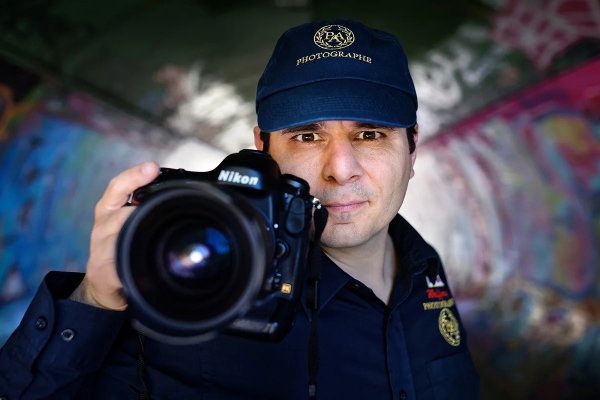
I am a French photographer and visual artist based in western France, where the Atlantic landscape remains an important source of inspiration for my work. Photography gradually became more than a way of recording the world around me: it became a way of slowing down, paying attention, and approaching what often remains unnoticed.
My journey began with a strong attraction to landscape, light, weather, and the transformations of natural spaces. Over time, my practice has evolved toward a more personal and poetic language. I am interested not only in what a place looks like, but also in what it can make us feel: a sense of suspension, fragility, movement, or inner resonance.
Today, I work across landscape, fine-art photography, and more collaborative projects involving the human figure. My aim is not simply to show a subject, but to create images that leave space for contemplation and imagination.
2. Can you share the story or inspiration behind your award-winning piece? How does winning this award make you feel about your journey in photography?
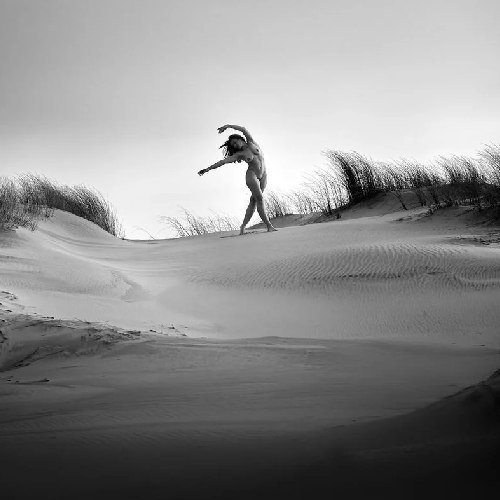
Wind Dance was born from an earlier landscape project created in the dunes near the Coubre Lighthouse, on France’s Atlantic coast. I was struck by the vegetation there, especially the beach grass bent and shaped by the wind. The dunes seemed animated by an invisible current: the plants did not merely endure the wind; they appeared to move with it.
While working on these landscapes, I began to imagine that a dancer could naturally extend this movement. That intuition became a collaboration with Fleur. Rather than placing a body in the landscape as an isolated subject, we sought to let her gesture enter into dialogue with the curves of the dune, the bent vegetation, and the direction of the wind.
The result is a photograph about movement, but also about belonging. The body does not dominate the landscape; it becomes part of its rhythm.
Receiving these awards, including two Platinum special prizes, is deeply meaningful. They are not only a recognition of a single image, but also an encouragement to continue exploring the meeting point between the human presence and the living forces of nature.
3. How do you decide which photo to submit for a competition?
I do not choose an image only because it is technically strong or immediately striking. I look for photographs that hold together on several levels: composition, light, emotion, and a personal sense of necessity.
I also consider whether an image can stand on its own outside the wider series from which it comes. In a competition context, a photograph must be able to create an immediate connection while still preserving its mystery.
Finally, I pay close attention to the categories and to the identity of each award. The aim is not to adapt the work artificially to a competition, but to find the right place for each image so that its visual language can be understood in its own terms.
4. What first made you pick up a camera?
At first, I was drawn to photography by a simple desire to preserve fleeting moments: a light, a landscape, an atmosphere that seemed impossible to hold onto. A camera offered a way to pause and to look more carefully.
Very quickly, I understood that photography was not only about keeping a trace. It changed the way I moved through the world. It taught me patience, attention, and the value of waiting for a place, a gesture, or a weather condition to reveal itself.
That first impulse has remained with me. I still photograph because certain moments seem to ask for more than a quick glance: they ask to be observed, inhabited, and transformed into an image.
5. What’s your favorite type of photography, and why do you love it?
Fine-art photography is the field where I feel most free, especially when landscape and human presence can meet. I enjoy starting from the reality of a place while allowing the image to move beyond description.
Landscape photography gives me access to the forces that shape our environment: water, wind, clouds, erosion, tides, and changing light. The human figure brings another dimension: scale, vulnerability, gesture, and emotion. When these elements enter into dialogue, an image can become less documentary and more evocative.
I love photography most when it does not close meaning, but opens it — when it allows the viewer to project memories, sensations, or questions of their own.
6. What’s your go-to camera setup, and why does it work best for your projects? What’s your favorite feature?
For a project such as Wind Dance, versatility is essential. The conditions can change rapidly outdoors: the wind shifts, the light changes, and the model’s gestures cannot be repeated in exactly the same way.
For this image, I used a Canon RF 28–70mm f/2L lens. Its range allowed me to adapt quickly, moving from a wider relationship with the dune to a more concentrated framing of Fleur and the vegetation. The constant f/2 aperture was also particularly valuable, because it gave me creative freedom in controlling depth of field.
I used filters both to work at f/2 in strong daylight and to shape the visual atmosphere. A dual half-diopter filter helped amplify selective blur and create a more ethereal, dreamlike feeling directly in-camera.
My favourite feature is not one particular technical setting, but this ability to respond without interrupting the flow of the scene. The best equipment is the equipment that lets the photographer remain fully attentive to the moment.
7. If someone looked at your work, what’s the one thing you’d want them to feel?
I would hope they feel a moment of connection with the living world.
Nature is not, for me, a background or a stage set. It is an active presence: water moves, wind draws lines through grass, clouds alter our sense of space, and light continually changes the meaning of a place.
Through my photographs, I try to invite viewers to pause and to experience this presence more intensely. If an image can make someone feel the wind, sense the scale of a landscape, or remember their own relationship with a natural place, then it has found its purpose.
8. What was the most challenging part of capturing your winning shot?
The main challenge was finding a section of dune that remained completely intact: without footprints, with rich vegetation, and with a topography that could support the composition and movement we had in mind.
This sounds simple, but it required real care. We did not want to become the source of the footprints we were trying to avoid. Fleur had to take a long route around the dune, carefully circling the sandy rise so that her approach would not leave visible traces in the frame.
That practical constraint became part of the process. It reminded us that working in a natural environment means adapting to the place rather than treating it as a studio. The image depends on this respect for the landscape and on the patience required to preserve its apparent untouchedness.
9. Is there a specific place or subject that inspires you the most?
The Atlantic coast of western France is one of my deepest sources of inspiration. It is a territory of transitions: land and sea, calm and storm, permanence and erosion, the visible and what is always changing beneath it.
I return often to dunes, estuaries, marshes, flooded landscapes, forests, and the coastline. These places are never truly the same twice. Weather, tide, season, and light continuously reshape them.
I am also increasingly inspired by the human figure when it can enter into a respectful dialogue with these environments. In that meeting, the body becomes neither an intrusion nor a symbol imposed upon nature, but a fragile, living presence within it.
10. Who or what has been your biggest influence in photography?
My strongest influence is nature itself, especially its ability to transform ordinary places into shifting, almost unreal spaces. Wind, water, fog, clouds, and light are constant teachers because they never repeat themselves and cannot be fully controlled.
I have also been influenced by photographers and visual artists who treat landscape as an emotional and poetic space rather than a simple subject to document. More broadly, literature, painting, cinema, and music all nourish the way I think about an image.
I am particularly drawn to works that leave room for ambiguity — images that do not explain everything, but invite the viewer to remain a little longer.
11. What message would you share to inspire photographers to participate in photography awards, and what advice would you give to help them excel in the competition?
Photography awards can be valuable opportunities to place one’s work in dialogue with a wider international audience. Beyond prizes, they can create visibility, encourage self-reflection, and sometimes open unexpected conversations and opportunities.
My advice would be to submit images that genuinely represent your visual identity. Do not chase trends or try to second-guess every jury. A competition is unpredictable, but an image with a sincere point of view has a stronger chance of remaining memorable.
It is also important to read categories carefully, edit rigorously, and submit fewer images if necessary. Choose photographs that are technically accomplished, but above all coherent with your artistic intention. Recognition is rewarding, but the most important thing is to remain faithful to the work you truly want to make.
12. What’s one piece of advice for someone just starting in photography?
Learn to look before trying to impress.
Technical knowledge is important, but it becomes meaningful only when it serves an intention. Spend time observing light, forms, colours, people, and places. Photograph often, revisit the same subjects, and allow yourself to make unsuccessful images: they are part of the learning process.
Most importantly, be patient. A personal style cannot be forced. It grows slowly, through curiosity, practice, editing, doubt, and repeated attention to what moves you personally.
13. What role do editing and post-processing play in your creative workflow?
Post-processing is an important stage, but it must remain faithful to the initial visual intention. I see it as a continuation of the photographic act: a way of clarifying atmosphere, balance, rhythm, and the emotional direction of an image.
For Wind Dance, the post-production was deliberately restrained. It consisted mainly of a panoramic recomposition and the final black-and-white treatment. The essential visual effects — including the selective, ethereal blur — were created during the shoot through the choice of lens, aperture, filters, and camera position.
For me, editing should not replace the experience of photographing. It should help the image become more fully itself.
14. How do you see technology, like AI, influencing the future of photography and your own approach?
Technology has always transformed photography, from the evolution of cameras and lenses to digital editing and new methods of image distribution. AI will undoubtedly expand creative possibilities, challenge existing definitions of photographic truth, and make visual creation more accessible.
At the same time, it makes the authenticity of a photographic encounter even more meaningful. My own work remains rooted in being present in a real place, waiting for light and weather, responding to chance, and building trust with the people I photograph.
I am interested in technology when it helps me see more freely or work more precisely. But I do not want it to replace the physical and emotional experience at the heart of photography: standing before the world and allowing it to surprise me.
15. If you could photograph anything or anyone in the world, what would it be?
More than a particular person or famous place, I would like to continue photographing landscapes at moments when they seem to cross a threshold: after a storm, at the edge of a flood, beneath fog, at dawn, or when a familiar place suddenly becomes strange.
I would also be interested in creating collaborative work with dancers and performers in powerful natural environments: deserts, volcanic landscapes, glaciers, coastlines, or forests. Not to impose a spectacle on these places, but to explore how a human gesture can become a quiet response to the scale and energy of the world.
What attracts me most is not a destination in itself, but the possibility of an image where light, landscape, movement, and emotion come together unexpectedly.