Martina Prša
1. Congratulations on winning in the European Photography Awards! Can you share a little about yourself, what inspired you to pursue photography, and how has your journey evolved since your first shot?
Thank you! I’m Martina Prša, a photographer and artist from Slovenia, also known as Foto Tinca. Creativity has always been an important part of my life, whether through art, poetry, or music, and photography has become another way for me to express how I see and experience the world.
I bought my first DSLR about four years ago, originally to photograph the handmade jewellery and other creative work I was making. What began as a practical purchase quickly became a passion. I started teaching myself, experimenting with the camera, and discovering just how much there was to explore. As a recreational horse rider, I was naturally drawn to equine photography, and horses remain especially close to my heart.
Over time, my interests expanded into nature, macro photography, landscapes, and increasingly, fine art. I became fascinated not only by what I could capture, but also by what I could create from my photographs. Editing became an extension of my artistic process—a space to explore atmosphere, emotion, and unexpected connections between images.
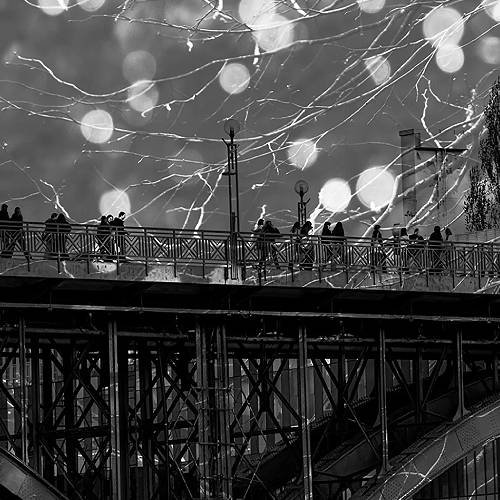
Since those first shots, my work has grown more experimental and personal. This year’s Gold-winning image, “Between the Lines of Reality,” reflects that development: it brings together observation and imagination. I’m still learning, but I’m also becoming more confident in allowing my own artistic voice to guide the work.
2. Can you share the story or inspiration behind your award-winning piece? How does winning this award make you feel about your journey in photography?
“Between the Lines of Reality” explores the space between what we see and what we imagine. It brings together an everyday urban scene—people crossing a bridge—with delicate lines and luminous details that give it an almost dreamlike atmosphere. The solid structure of the bridge contrasts with the fragility of the overlapping elements, turning a familiar scene into something less certain and more open to interpretation.
This reflects what I love about fine-art photography: a photograph can be both a record of a moment and the beginning of an entirely different story. Through layering and creative editing, I can explore connections between my photographs and give them a meaning that extends beyond their individual subjects. I also like leaving room for viewers to discover their own stories within the image.
Receiving Gold for this work is deeply encouraging. As a self-taught photographer, I still question myself and continually look for ways to improve. Having such a personal, experimental piece recognised gives me confidence to keep exploring and to trust my artistic instincts. It does not mean that I have reached a final destination, but it makes me feel that the direction I am taking is worth pursuing.
3. How do you decide which photo to submit for a competition?
It is a combination of intuition and critical judgement. I usually begin with photographs that I feel strongly connected to—images that make me pause, whether because of their atmosphere, emotion, or an unusual visual connection. Then I try to step back and consider how they might speak to someone who knows nothing about the circumstances behind them.
I look at composition, light, technical quality, and whether the editing supports the idea. I also consider the competition’s categories and requirements, because choosing the right context for an image matters, especially with creative or composite work.
The decision is not always easy; being attached to a photograph can make it difficult to judge objectively. Ultimately, I want to submit work that represents my own vision and that I am proud to stand behind, even when the result is uncertain.
4. What first made you pick up a camera?
I had always enjoyed taking photographs, but what prompted me to buy my first DSLR was quite practical: I wanted better photographs of the handmade jewellery and other creative pieces I was making. I had no idea that the camera would become a creative outlet in its own right. Once I started experimenting, curiosity took over. I bought it to photograph the things I created, and ended up discovering another way to create.
5. What’s your favorite type of photography, and why do you love it?
Honestly, I don’t think I have found one favourite yet. I am still experimenting, and that is part of what I love about photography. Horses have a special place in my life, so photographing them feels natural, but I also enjoy exploring macro, nature, landscapes, and creative fine-art work.
Each offers something different—a connection with an animal, the discovery of a tiny detail, or the freedom to transform photographs into something unexpected. For now, I would rather follow my curiosity than limit myself to one genre. I am still discovering what I most enjoy and where it might lead me.
6. What’s your go-to camera setup, and why does it work best for your projects? What’s your favorite feature?
My go-to camera is the Canon EOS 90D, often paired with the Canon EF 70–300mm f/4–5.6 IS II USM for photographing horses, wildlife, and more distant subjects. For close-up work, I use a Sigma 105mm f/2.8 Macro, which lets me explore the small details and textures that draw me to macro photography.
This combination suits me because I am still experimenting with different subjects and approaches. It gives me room to explore without being tied to one type of photography.
What I enjoy most is shooting in manual mode. I like making deliberate choices about movement, light, and depth of field, and seeing how those choices change the image. Canon’s controls feel intuitive to me, and that familiarity helps me concentrate on the photograph I want to create.
7. If someone looked at your work, what’s the one thing you’d want them to feel?
A sense of connection. I would love someone to pause in front of an image and find something of themselves in it—a feeling, a memory, or a story that only they can recognise. It does not have to be the same thing I felt when creating it. I like the thought that a photograph can begin with my way of seeing and become something personal to someone else.
8. What was the most challenging part of capturing your winning shot?
The challenge came in two stages: first, capturing the bridge at the right moment, with people moving across it and the composition constantly changing. Then came finding another photograph to combine with it—one that would bring the work to life as a whole. It was about finding a connection between the two images so that together they became something neither could be on its own.
9. Is there a specific place or subject that inspires you the most?
I fall in love with different things, moments, and motifs all the time. I am an artist, and my inspiration does not stay in one place or belong to one subject. A horse, a flower, a fleeting expression, or light falling across an ordinary scene can all capture my imagination. It is less about what I am looking at and more about what it awakens in me. That sense of discovery is what keeps me creating.
10. Who or what has been your biggest influence in photography?
I have never looked up to anyone in particular in photography. My motivation comes from wanting to create something I am proud of—something that makes me feel alive and, hopefully, awakens that same feeling in the viewer.
My point of reference is my own growth. With every image I take and create, I want to become better than I was before, to explore further, and to find new ways of expressing what I feel. That desire to keep discovering what I am capable of is what drives me.
11. What message would you share to inspire photographers to participate in photography awards, and what advice would you give to help them excel in the competition?
Give your work a chance to be seen. It can feel intimidating to submit something personal for judgement, but you do not have to feel completely confident before taking that step. Awards can be an opportunity to share your vision and reflect on how far you have come.
My advice is to choose work you genuinely believe in, look at it critically, and pay attention to both the artistic idea and its execution. Read the requirements carefully and consider which category best suits your image. There is no guaranteed formula for winning, but you can make sure that what you submit is thoughtful, carefully finished, and true to you.
Above all, keep creating work that makes you feel alive. Recognition is wonderful, but one competition’s result should not become the final verdict on your abilities. Let it be part of your journey, and keep striving to become better with every image.
12. What’s one piece of advice for someone just starting in photography?
Give yourself permission to experiment. Learn how your camera works, but do not feel that you must have a recognisable style or a favourite genre from the beginning. Photograph what catches your attention, try different approaches, and allow yourself to make mistakes. You discover what you love by doing it. Above all, enjoy the process—let curiosity lead you, rather than the pressure to prove yourself.
13. What role do editing and post-processing play in your creative workflow?
Editing plays a significant role in my creative workflow. For me, taking the photograph is often the beginning; post-processing is where I explore what else it can become. I enjoy experimenting with light, colour, contrast, and layers, discovering possibilities that may not have occurred to me when I pressed the shutter.
Sometimes I want to enhance the atmosphere already present in a photograph. At other times, I combine my images to create something entirely new, as I did with “Between the Lines of Reality.” Finding that connection—when two photographs come to life as a whole—is especially rewarding.
It is a part of the process where the artist in me has room to play. I do not always begin with a fixed outcome; often, the idea develops through experimentation until the image feels complete.
14. How do you see technology, like AI, influencing the future of photography and your own approach?
I see AI as a companion that can support my work and make parts of the process faster when needed, but certainly not as a substitute for my camera or my own creative vision. For me, photography still begins with experiencing a moment, noticing something, and choosing how to capture it.
I believe technology’s most valuable role in the future of photography is to help photographers realise their ideas while leaving the creative decisions in their hands. In my own approach, I welcome that support, but I want the image—and the vision behind it—to remain mine.
15. If you could photograph anything or anyone in the world, what would it be?
Honestly, I don’t have one particular subject in mind. I keep discovering new things that interest me, and sometimes the fascination comes after I have taken the photograph. When I revisit my images, a motif can suddenly draw me in more deeply than it did at the time.
That element of surprise is something I love about photography. Perhaps my answer is simply: something I haven’t yet discovered.