Benoit Rondelet
1. Congratulations on winning in the European Photography Awards! Can you share a little about yourself, what inspired you to pursue photography, and how has your journey evolved since your first shot?
I am a Belgian thoracic surgeon, lung transplant specialist, and university professor. For much of my professional life, I have worked at the intersection of science, technology, and the most fundamental questions of human existence: life, vulnerability, and the limits of what we can repair.
Photography gradually opened another way of looking at these questions. During the COVID-19 pandemic, when I was serving as Medical Director of the CHU UCL Namur Group in Belgium, I experienced the fragility of life with particular intensity. I became increasingly aware that the living world surrounding us was facing its own existential crisis, often silently and out of sight.
Wildlife photography became a way for me to bear witness to this reality. What began as a passion gradually evolved into a more profound artistic and ethical commitment. I became particularly interested in great apes, whose intelligence, emotional sensitivity, and complex social relationships challenge our traditional understanding of the boundary between humans and other animals.
Since my first photographs, my approach has evolved from wanting to capture beautiful moments to wanting to create images that carry meaning. I still care deeply about light, composition, and technical excellence, but these are means rather than ends. I want my photographs to create a connection, to invite reflection, and perhaps to change the way someone looks at the natural world.
Today, I see myself less as someone who photographs wildlife than as someone who tries to tell the story of our shared existence through images.
2. Can you share the story or inspiration behind your award-winning piece? How does winning this award make you feel about your journey in photography?
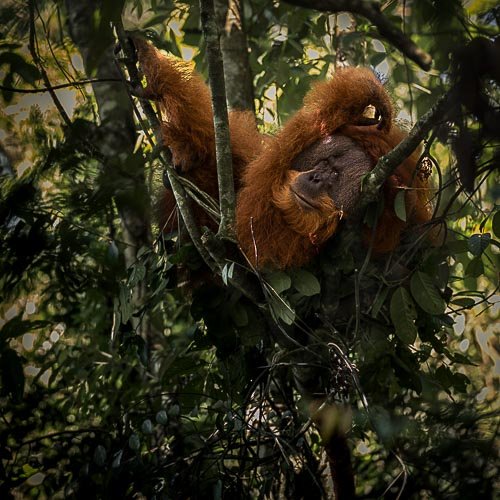
My award-winning photographs portray orangutans in Sumatra and Borneo, two islands where the extraordinary richness of tropical forests coexists with the growing threats of habitat destruction. But beyond documenting these remarkable animals, my intention is to reveal something that goes much deeper than their beauty or rarity.
When I look into the eyes of an orangutan, I do not see a distant, exotic creature. I see a living being with whom I share a common evolutionary heritage. I see expressions, emotions, and behaviours that resonate with something profoundly familiar. I am reminded that we are not fundamentally separate from these animals. We belong to the same great family of life. Humans are great apes too, and our evolutionary story is inseparable from theirs.
Through my photographs, I want to challenge the artificial boundary we have constructed between humanity and nature. We often speak about nature as though it were somewhere else, a world outside our cities, our societies, and our daily lives. Yet we do not live alongside nature as external observers. We are part of it. We emerged from it, depend upon it, and remain bound to it through countless biological and ecological connections.
Orangutans make this relationship particularly tangible. Their intelligence, their capacity to learn, their long childhoods, and their complex relationships reveal a richness of life that deserves recognition in its own right. At the same time, their future is increasingly threatened by the destruction of the forests they inhabit. I find this contradiction deeply troubling: the very species capable of understanding the world on an extraordinary scale is destroying the living systems that sustain it.
I want my photographs to create a moment of recognition. Perhaps, when someone looks at an orangutan's face, they will no longer see simply an animal, but a relative. Perhaps they will begin to question where humanity truly stands within the natural world.
Winning the European Photography Awards is therefore a meaningful encouragement. It gives greater visibility to a message that I believe is essential today. I am grateful for this recognition, not simply because it acknowledges my work, but because it offers another opportunity to share this vision with a wider audience.
For me, the greatest achievement would be for these photographs to leave viewers with a simple but profound realisation: when we destroy nature, we are not destroying something external to ourselves. We are damaging the very living world from which we come, and upon which our future depends.
3. How do you decide which photo to submit for a competition?
I begin with a simple question: does this photograph have something to say beyond what it shows?
Technical quality is essential. Light, focus, composition, timing, and the treatment of the image must all serve the photograph. But technical perfection alone rarely makes an image memorable. I look for something less easily defined: a presence, a tension, an emotion, or a moment of connection that gives the photograph its own identity.
I also ask myself whether the image reflects my personal vision. I do not want to submit a photograph simply because I believe it will appeal to a jury or fit a particular trend. I would rather defend an image that expresses my convictions than choose one solely for its immediate visual impact.
I try to imagine what remains after the first impression has passed. Does the image invite a second look? Does it raise a question? Does it reveal something about the animal, its environment, or our relationship with the living world?
Finally, I consider the coherence between the photograph and the story I want to tell. For me, competitions are an opportunity to share a vision, not merely to demonstrate technical ability. The strongest image is the one in which artistic intention and personal meaning become inseparable.
4. What first made you pick up a camera?
I was first drawn to photography by the desire to preserve moments that I knew would never happen in quite the same way again. Nature has an extraordinary capacity to surprise us, but these encounters are often fleeting. A glance, a gesture, a shaft of light through the forest, or an unexpected interaction can disappear in a fraction of a second.
The camera offered me a way to retain something of these encounters and share them with others.
Over time, however, I realised that photography was teaching me something more important than how to capture a moment. It was teaching me how to pay attention. To photograph wildlife well, I must slow down, observe, anticipate, and accept that nature follows its own rhythm rather than mine.
There is also a connection with my medical profession. As a surgeon, I have learned to observe closely, to recognise subtle details, and to understand the importance of precision. Yet photography invites me to complement that analytical perspective with intuition, emotion, and contemplation.
What began as a desire to preserve beautiful moments has become a way of questioning my place in the world. The camera is no longer simply a tool for recording what I see. It has become a means of exploring what I feel, what I understand, and what I believe deserves to be protected.
5. What’s your favorite type of photography, and why do you love it?
I was first drawn to photography by the desire to preserve moments that I knew would never happen in quite the same way again. Nature has an extraordinary capacity to surprise us, but these encounters are often fleeting. A glance, a gesture, a shaft of light through the forest, or an unexpected interaction can disappear in a fraction of a second.
The camera offered me a way to retain something of these encounters and share them with others.
Over time, however, I realised that photography was teaching me something more important than how to capture a moment. It was teaching me how to pay attention. To photograph wildlife well, I must slow down, observe, anticipate, and accept that nature follows its own rhythm rather than mine.
There is also a connection with my medical profession. As a surgeon, I have learned to observe closely, to recognise subtle details, and to understand the importance of precision. Yet photography invites me to complement that analytical perspective with intuition, emotion, and contemplation.
What began as a desire to preserve beautiful moments has become a way of questioning my place in the world. The camera is no longer simply a tool for recording what I see. It has become a means of exploring what I feel, what I understand, and what I believe deserves to be protected.
6. What’s your go-to camera setup, and why does it work best for your projects? What’s your favorite feature?
For my wildlife photography, I rely on the Canon EOS R3 and Canon EOS R5 Mark II, paired with Canon RF telephoto lenses suited to the conditions in which I work. Depending on the subject, distance, and available light, I use long telephoto zooms, including the RF 100–300mm, as well as longer focal lengths when I need to photograph animals without disturbing their behaviour.
This equipment allows me to adapt to very different situations. In dense tropical forests, light can be extremely challenging, and encounters with wildlife are often brief. I need a camera that responds quickly and reliably, with excellent autofocus, strong performance at high ISO settings, and the ability to capture subtle expressions or fleeting interactions.
My favourite feature is the autofocus system, particularly its ability to recognise and track animal subjects. When photographing great apes, the eyes are often the emotional centre of the image. Reliable eye detection allows me to concentrate on composition, gesture, and the evolving relationship between individuals rather than constantly worrying about focus.
At the same time, I never want equipment to become the centre of my photographic practice. The best camera is the one that allows me to respond to an encounter without getting in the way of it.
Technical performance matters enormously, but it remains in the service of something much more important: the ability to translate a moment of life into an image that conveys its emotional significance.
7. If someone looked at your work, what’s the one thing you’d want them to feel?
Connection.
I would like people to feel that the living world is not something external to them, a beautiful landscape to admire from a distance or a collection of species to protect out of goodwill. It is the community to which we ourselves belong.
When someone looks at a photograph of a great ape, I hope they can momentarily forget the familiar distinction between human and animal. I want them to recognise something of themselves in the subject's gaze, while also acknowledging that this individual has its own existence, its own relationships, and its own place in the world.
That moment of recognition can be deeply unsettling, because it challenges the idea that humanity stands apart from the rest of nature. But it can also be profoundly beautiful. It reminds us that our place in the world is defined not by domination, but by our capacity to understand and care.
If my photographs can create that connection, even for a few seconds, they have achieved something meaningful.
I do not necessarily expect every viewer to leave with a clear answer or a specific action in mind. I would simply like them to leave with a different question: if we are so deeply connected to the living world, how can we accept its destruction without recognising that we are also destroying something within ourselves?
8. What was the most challenging part of capturing your winning shot?
The greatest challenge was not simply photographing an orangutan successfully. It was finding a way to communicate, through a single image, the depth of what I feel when I encounter these animals.
In the forests of Sumatra and Borneo, orangutans live in an environment that is often difficult to photograph. The dense vegetation, the constantly changing light, and the distance between the photographer and the subject demand patience, anticipation, and technical precision. A meaningful encounter cannot be forced, and the photographer must learn to accept the rhythm of the forest.
But the real challenge begins beyond the technical aspects. How can I convey the intelligence, sensitivity, and individuality of an orangutan? How can I make a viewer feel that there is more than a beautiful animal in front of the lens? How can I reveal a shared history that extends millions of years into the past?
I believe the answer lies in the gaze, the expression, the posture, and the subtle details that transform an animal portrait into an encounter. I look for those fleeting moments when the subject seems to transcend the category in which we have placed it. The orangutan ceases to be merely an object of observation and becomes a presence with which we can identify.
I want the viewer to experience a kind of recognition: the unsettling yet beautiful awareness that the distinction between humans and other great apes is not an absolute divide. We share deep evolutionary roots. We are not strangers to one another, but different branches of the same remarkable story of life.
There is also an ethical responsibility in this process. I must remain a respectful observer, never allowing my desire for a photograph to interfere with the animal's natural behaviour. The encounter must come before the image.
Ultimately, my greatest challenge is to translate this experience into a photograph that speaks beyond words. I want to capture not only the appearance of an orangutan, but something of its humanity—not because it must resemble us to deserve protection, but because recognising our kinship can help us overcome the illusion that humanity stands apart from nature.
If a photograph can make someone pause, look into an orangutan's eyes, and reconsider their place in the living world, then I feel that I have achieved something far more important than capturing a technically successful image.
9. Is there a specific place or subject that inspires you the most?
Tropical forests have a particular place in my imagination, especially the forests of Central Africa and Southeast Asia, where great apes live in environments of extraordinary biological richness.
I am deeply moved by the forests of the Democratic Republic of the Congo and by the opportunity to encounter bonobos in their natural environment. My time with the NGO Mbou-Mon-Tour, near Bolobo, was particularly meaningful. The organisation works to protect bonobos while engaging local communities, and spending time there allowed me to appreciate that conservation is not simply about protecting animals. It is also about relationships, knowledge, culture, and the future of the people who share their environment.
I am equally fascinated by orangutans in the forests of Borneo. Their lives in the canopy, their remarkable intelligence, and their vulnerability to habitat destruction reveal both the extraordinary adaptability of life and its limits when confronted with relentless human pressure.
What inspires me most, however, is not a particular geographical destination. It is the encounter itself: the possibility of witnessing a wild animal in its own world, without reducing it to a spectacle.
These places remind me that a forest is much more than a collection of trees. It is a living network of relationships that has developed over millions of years. To photograph its inhabitants is also to bear witness to the extraordinary complexity of the world we are in danger of losing.
10. Who or what has been your biggest influence in photography?
I have been influenced by several photographers and naturalists, each of whom has taught me something different about the relationship between images and the living world.
Vincent Munier has shown me the power of silence, patience, and humility. His work reminds me that photographing nature often begins with learning to disappear into it.
Marco Gaiotti has inspired me through his ability to combine artistic sensitivity with a genuine commitment to conservation. His photographs demonstrate how beauty can become a powerful invitation to care.
Denis Palanque has influenced me through his documentary approach and his understanding of photography as a form of testimony. His work reminds me that an image can do more than describe a subject: it can reveal a threatened balance and make an invisible issue visible.
Maxime Aliaga has had a particularly important influence on my photographic journey, especially through his work with great apes and tropical forests.
Beyond his remarkable photographs, I admire his generosity as a mentor. He shares his knowledge with patience and humility, without treating experience as something to be guarded. He has helped me understand that the transmission of knowledge is itself a form of commitment.
I am also profoundly inspired by Jane Goodall and Dian Fossey, whose scientific work and determination transformed our understanding of great apes. David Attenborough has likewise demonstrated how science, wonder, and storytelling can work together to awaken a global awareness of biodiversity.
What connects all these influences is a shared conviction: looking at nature attentively should lead us toward a deeper understanding of our place within it. They have helped me see photography not simply as an artistic practice, but as a responsibility.
11. What message would you share to inspire photographers to participate in photography awards, and what advice would you give to help them excel in the competition?
I would encourage photographers to participate in awards, but above all, to remain faithful to their own vision.
International competitions offer valuable opportunities to share work with new audiences, discover other photographic approaches, and receive recognition from people who appreciate the craft. They can also help a meaningful project travel much further than the photographer could take it alone.
However, I believe it is important not to confuse recognition with purpose. An award can amplify a message, but it cannot replace the message itself.
My advice would be to select photographs that express something genuinely personal. Study the technical requirements and categories carefully, present your work professionally, and make sure that the image is strong enough to stand on its own. Composition, light, timing, and technical execution all matter. So does the ability to communicate an idea without relying on a lengthy explanation.
For wildlife photographers, I would add one essential principle: never compromise the welfare of an animal or the integrity of a natural environment for the sake of an image. Responsible photography is not a limitation on creativity; it is part of what gives the work its legitimacy.
Finally, do not let rejection discourage you. A competition jury represents a particular set of sensibilities, not an absolute measure of artistic value. Continue learning, experimenting, and developing your own visual language.
For me, the greatest success is not simply having a photograph selected or awarded. It is knowing that I have created an honest image that may inspire someone to look more carefully at the world and care more deeply about its future.
12. What’s one piece of advice for someone just starting in photography?
Learn to look before you learn to photograph.
It is tempting, especially at the beginning, to believe that better equipment will automatically produce better images. In reality, a camera can record what is in front of you, but it cannot decide what deserves your attention or why a particular moment matters.
Spend time observing light, studying composition, understanding your subject, and learning to anticipate what might happen next. If you photograph wildlife, take the time to understand animal behaviour and respect the distance they need. Patience will often teach you more than any new piece of equipment.
I would also encourage beginners to photograph what genuinely moves them rather than what they think other people will admire. A personal connection to a subject gives an image a depth that technical perfection alone cannot provide.
Finally, do not be afraid of making mistakes. Every unsuccessful photograph can teach you something about light, timing, focus, or your own intentions. Review your images critically, learn from other photographers, and remain curious.
Above all, remember that photography is not a race. There is no need to produce a masterpiece every time you pick up your camera. The important thing is to develop a way of seeing that is genuinely your own.
The more attentive you become to the world, the more meaningful your photographs will become.
13. What role do editing and post-processing play in your creative workflow?
Post-processing is an essential part of my photographic practice, but I see it as a way of completing an image rather than transforming it into something it was not.
I use Adobe Lightroom to refine exposure, contrast, colour balance, highlights, shadows, and detail. These adjustments help me reproduce more faithfully the atmosphere I experienced in the field and guide the viewer's attention toward what matters most in the composition.
In a tropical forest, for example, the light can be complex and the colours difficult to reproduce accurately. My aim is to recover the subtle relationships between the subject and its environment without losing the atmosphere that made the encounter meaningful.
I also believe that restraint is important. It is easy to become absorbed in technical possibilities and produce an image that is visually striking but disconnected from the reality of the encounter. I try to avoid excessive saturation, artificial-looking contrasts, or adjustments that exaggerate the animal's appearance.
For wildlife photography, integrity is fundamental. I do not want to misrepresent animal behaviour or create a false impression of the natural environment. The photograph should remain an honest testimony of something that existed in front of my camera.
For me, editing is therefore both an artistic process and an ethical responsibility. It allows me to express my vision while remaining faithful to the subject. The ultimate goal is not to make an image look more spectacular, but to help it communicate more clearly what I felt and observed.
14. How do you see technology, like AI, influencing the future of photography and your own approach?
I believe artificial intelligence will profoundly transform photography, just as previous technological developments have changed the way images are created, processed, and shared.
In wildlife photography, AI already offers valuable possibilities through subject recognition, autofocus, noise reduction, and increasingly sophisticated image-processing tools. These developments can help photographers work in difficult conditions and spend more time concentrating on composition, behaviour, and storytelling.
As someone who works in medicine, I am accustomed to technological progress. I have seen how powerful tools can extend human capabilities, but also how important it is to understand their limitations. Technology is most valuable when it serves a clear purpose rather than becoming an end in itself.
Generative AI raises additional questions. It can produce extraordinary images, but it also challenges our understanding of photography as a record of an encounter with reality. I see a fundamental distinction between using AI to improve the technical quality of a genuine photograph and generating an image that appears to document an event that never happened.
For my own work, authenticity is essential. My photographs are intended to bear witness to the living world, to the animals I encounter and the environments in which they exist. If an image is presented as a photograph of nature, I believe viewers should be able to trust that it reflects a real encounter.
I do not fear technological progress, but I believe it must be accompanied by transparency, responsibility, and respect for the audience.
Ultimately, no technology can replace the experience of standing quietly in a forest, waiting for an animal to emerge, or feeling the intensity of a genuine encounter. AI may help us create images, but it cannot substitute for the meaning of being present in the living world.
15. If you could photograph anything or anyone in the world, what would it be?
I would choose to spend an extended period in the heart of a primary tropical forest, photographing great apes in their natural environment without the pressure of time.
I would love to follow the lives of a bonobo or orangutan community over several months, observing their relationships, their learning, their conflicts, their moments of tenderness, and the ways in which knowledge is transmitted from one generation to another.
I would want to tell a story that goes beyond individual portraits: a story about the richness of their social worlds, the complexity of their relationships, and the fragility of the environments on which their future depends.
Ideally, this project would also include the people who work to protect these forests and the communities who live alongside great apes. I believe that a meaningful conservation story cannot be told by photographing animals alone. It must also acknowledge the human realities, challenges, and hopes that shape the future of these ecosystems.
I would not necessarily seek a rare or spectacular image. I would be just as interested in an ordinary moment that reveals something extraordinary: a mother teaching her offspring, two individuals sharing a moment of quiet companionship, or a young animal discovering its world.
Ultimately, I would like to create a photographic story that brings viewers closer to these beings and makes their disappearance impossible to regard with indifference.
My greatest ambition would be to photograph a world in which great apes are no longer fighting for survival, where their forests remain intact, and where humanity has finally understood that protecting the living world is not an act of generosity toward something external to ourselves.
It is an expression of our responsibility toward the world to which we belong.